Delight Is the Only Thing That's Still Rare
I installed four new apps last week. Two were AI wrappers for things I already do. One was a project management tool that looked identical to every other project management tool. The fourth was a notes app that someone had posted on Hacker News. I deleted three of them within a day. The notes app is still on my phone because when I opened it, the cursor was already blinking in a new note. No onboarding. No account. No tour of features I didn't ask about. Whoever built it had thought about what I wanted in the first two seconds and got out of the way.
That's delight. And it has always been rare.
What changed and what didn't
Before AI tools got good at writing code, building a mediocre app still took weeks of work. Writing a forgettable article still took a few hours. Making generic art still required learning to draw, or at least learning Photoshop. The effort involved acted as a filter. Plenty of bad things still got made, but the cost of making them meant that the ratio of bad-to-good stayed roughly stable. You could browse a product directory or read through a blog feed and expect to find something worthwhile within a few minutes.
That ratio has changed. The tools that make creation cheap don't have any preference for quality. They're equally good at producing a thoughtful app and a pointless one, a careful article and a rehash of five other articles. The result is that we now have vastly more of everything, but the number of things that are actually good hasn't moved much.
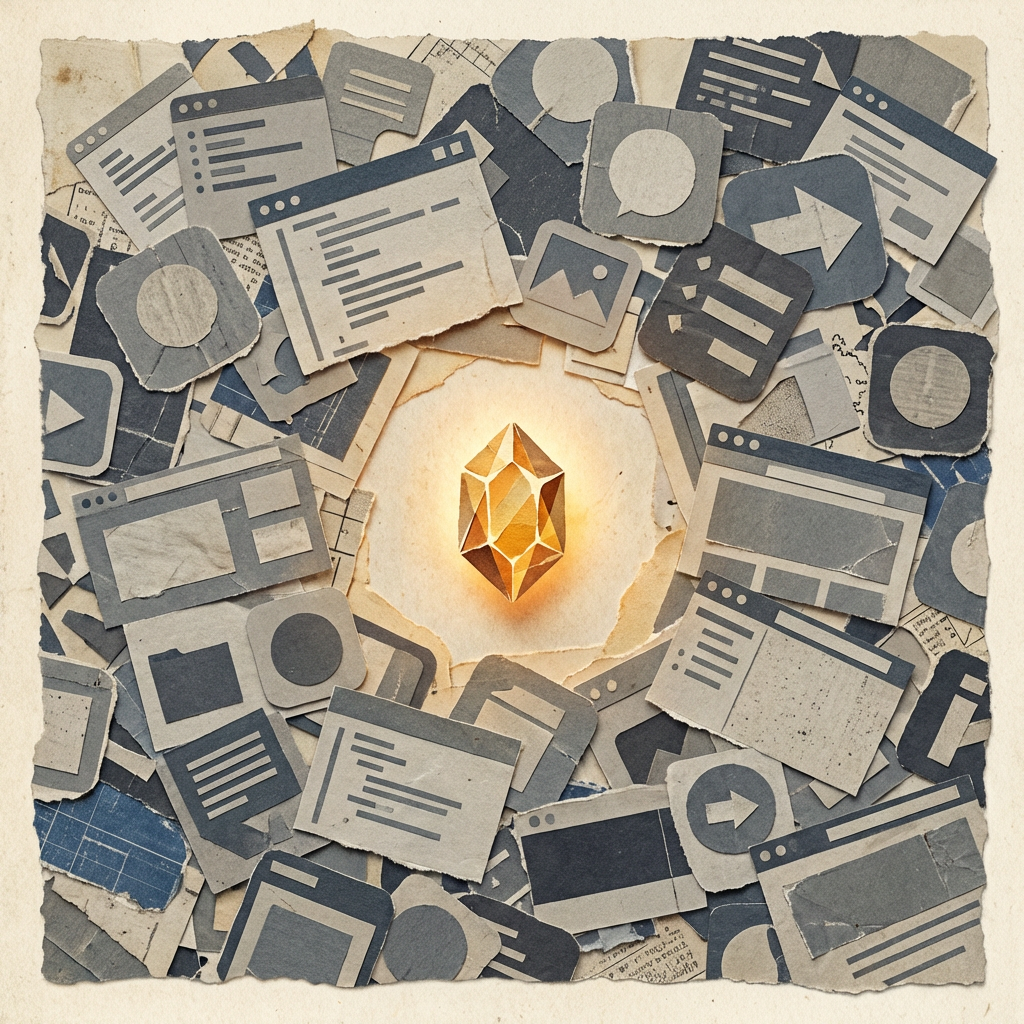
This creates a different kind of problem than the one we had before. The old problem was scarcity: good things existed but were hard to find because there weren't enough of them, and distribution was expensive. The new problem is signal collapse. Good things still exist in roughly the same numbers, but they're buried under an avalanche of adequate ones. A Show HN post used to carry information: someone cared enough to build this and put their name on it. Now I often can't tell if a project represents months of careful work or a weekend of prompting, so I skip it. I feel bad about that, because some of those projects are genuinely good. But I don't have a way to tell which ones without investing the time to try each of them, and I don't have that time.
The gap between viable and delightful
The product community has been arguing about the Minimum Delightful Product for years. A Minimum Viable Product is something users won't immediately uninstall. A Minimum Delightful Product is something they'll tell a friend about. The gap between those two has always existed, but it used to cost a lot to cross it. You needed engineers, designers, time, and judgment. Now the viable part is nearly free. You can prompt an AI agent to build a working CRUD app in an afternoon. The gap hasn't shrunk, though. The cheap side got cheaper, and the expensive side stayed the same.
What makes the notes app on my phone delightful while the other three apps were forgettable? Nothing dramatic. The loading time is fast enough that I don't notice it. The text size is comfortable without me adjusting it. When I search for a note, the results appear as I type and the match is highlighted so I can scan without reading. When I accidentally swipe a note away, it asks me to confirm with a single tap, not by typing "DELETE" into a modal. These details accumulate. Individually, none of them would make me recommend the app. Together, they make me trust that whoever built it actually uses it, because they've fixed all the small things that would annoy a real user.
Noticing those details and caring enough to fix them is what people in the industry call product engineering. A product engineer isn't a designer and isn't a project manager. They're a developer who has opinions about what should happen when a user taps the wrong button, or what the empty state of a screen should say, or whether a feature should exist at all. They use the product themselves, feel the friction, and remove it.
AI can write the code to implement a feature. What it can't do is notice that the feature belongs in a different part of the app, or that changing two words in a button label would reduce support tickets by half, or that the user would be better served by removing the feature entirely. That kind of judgment comes from using the thing and caring about the experience of using it. You can't specify it in a prompt, because the person writing the prompt would need to already know the answer.
As building gets cheaper, this kind of judgment becomes the differentiator. Two developers can ship identical feature lists over a weekend. The one whose app feels good to use will keep users. The other one will become another entry in a crowded app store that nobody opens twice.
Why trust has become the main filter for quality
I follow Patrick McKenzie (@patio11) online. When he recommends a long article, I read it. I don't check who wrote it or whether AI was involved. His track record of finding valuable things is strong enough that his recommendation alone is worth my time. He has skin in the game: every bad recommendation slightly erodes the trust he's built over years, so he's careful about what he shares.
Compare that to an AI recommendation engine. When an algorithm surfaces an article, it has no reputation at stake. It loses nothing by pointing me at something mediocre. It can't be embarrassed by a bad pick. The recommendation carries no information about quality, only about engagement patterns and keyword matches.
This distinction matters for more than articles. A friend of mine has a piece of AI-generated art printed and framed in his living room. I've looked at it carefully, because his decision to print it and hang it tells me something. He scrolled through hundreds of generated images, found one that meant something to him, and committed to living with it on his wall. That act of curation carries real signal. By contrast, when someone sends me a folder of 50 AI images they generated that afternoon, I glance at the first two and close the folder. There's no filter applied, so there's no reason to expect any given image to be worth my attention.
The same pattern shows up everywhere. I trust a restaurant recommendation from someone who eats out regularly and has strong opinions about food. I don't trust a recommendation from a system that lists every restaurant within three miles sorted by star count. I trust a book recommendation from a friend who reads 40 books a year and only mentions the ones that stuck with them. I don't trust a "readers also bought" carousel.
What these trusted sources have in common is cost. The friend who recommends a restaurant is spending their credibility. If they send me somewhere bad, I'll trust their next recommendation a little less. That cost is what makes the recommendation meaningful. AI systems and algorithmic feeds don't pay that cost, so their recommendations carry less weight, even when the underlying content is good.
What this means for people who build things
If you're building software, the competitive moat isn't features anymore. Someone can replicate your feature list over a weekend. The moat is accumulated attention to detail, the hundred small decisions that make your product feel right. Those decisions don't show up in a feature comparison table, and they can't be replicated by prompting an AI to "make it like Notion but for X."
The way people will find your product, if it's good, is through personal recommendations from people they trust. That's how it's always worked for the best products, but it matters more now because the alternative discovery channels are flooded. App store search results are full of AI-generated clones. Product Hunt launches happen every few hours. Google results are increasingly polluted with AI-generated SEO content. The channels that used to help people discover good things are degraded.
So building something great is necessary but not sufficient. You also need people who use it to care enough to tell others about it, and those others need to trust the person doing the telling. The chain of trust from builder to user to advocate is the only distribution channel that hasn't been diluted.
If you're building a reputation as someone who finds and recommends good things, that reputation is becoming more valuable. The noisier the world gets, the more people rely on trusted curators. A newsletter where someone shares one good tool a week, with real context about why they use it, is more valuable than a directory of 10,000 tools sorted by category. A developer who blogs about the specific stack they chose for their own project, and explains the tradeoffs honestly, provides more signal than a comparison article that benchmarks 15 frameworks on criteria nobody cares about.
If you're making things with AI, the AI part doesn't matter. Nobody cares that your app was vibe-coded, or hand-written, or built by a team of 50. They care whether it's good. The interesting question isn't whether AI was involved in making the thing. It's whether someone with taste was involved in deciding what the thing should be, and whether they stuck around long enough to get the details right.
More apps will ship this year than in the previous decade combined. The vast majority will be adequate and forgettable, because adequate is now free. The ones that survive will be the ones where someone cared about every pixel, every error message, every loading state. Those people will find their audiences through word of mouth from people whose recommendations mean something. Everything else is noise.